
What Is Big Data?
Big Data is the order of the day and is part of almost every technology/tool/software that comes into the market promising real time solutions.
Big data in marketing has definitely come to stay and is playing a huge role in digital marketing where data is collected online at every touch point when the customer interacts with the web site.
The explosion of data is going on at breakneck speed. As of date, over 2.5 quintillion bytes of data (or 1000 to the sixth power referred to as an exabyte) is created every day, both human created and machine to machine data. 90% of the data generated in the world has happened just in the past two years.
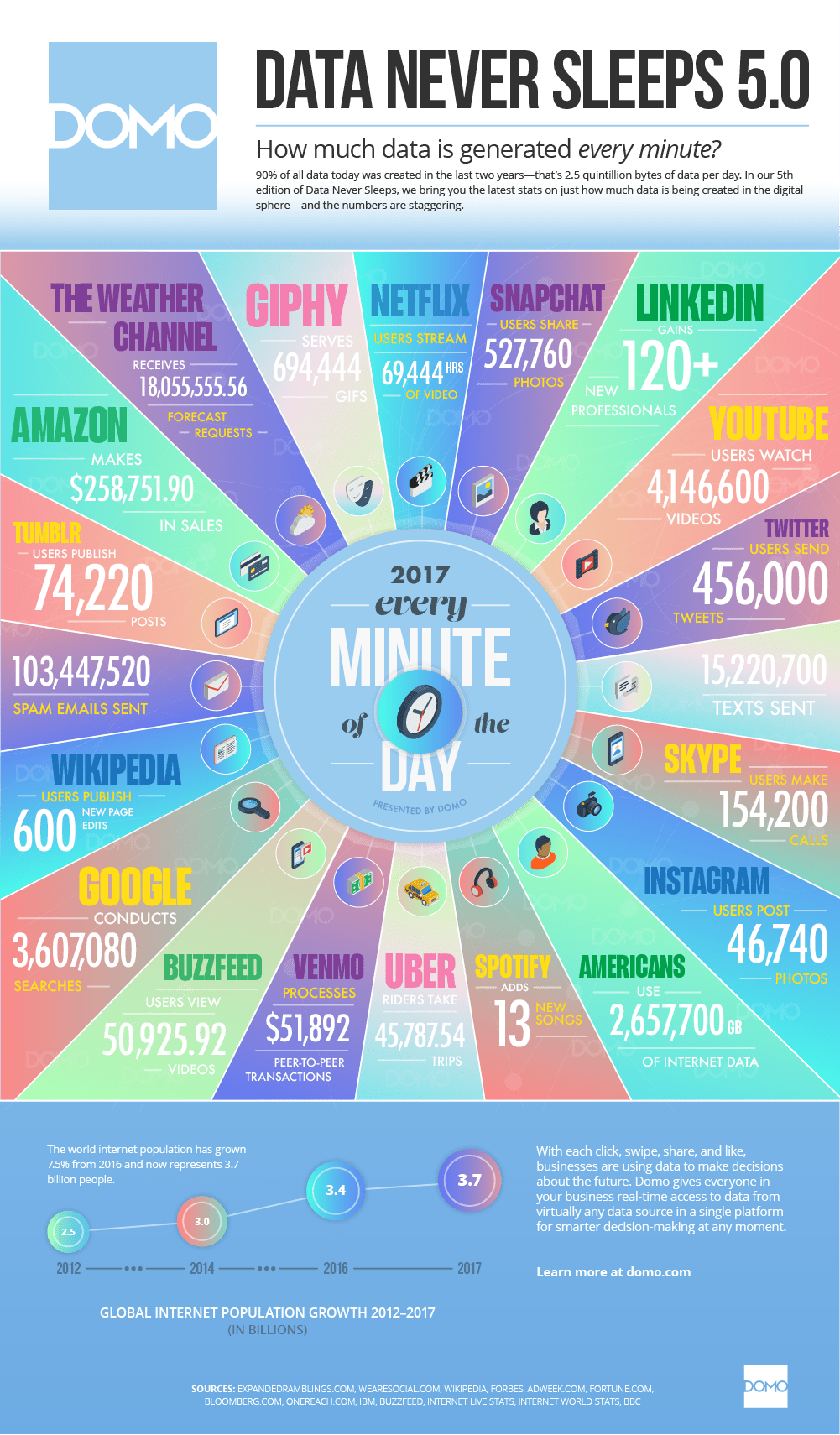
Source: https://www.domo.com/learn/data-never-sleeps-5?aid=ogsm072517_1&sf100871281=1
Big Data is made up of massive sets of data, subjected to analytical and statistical rigor, that culminates in finding trends and patterns in any market, hugely beneficial to small and big businesses involved therein.
What is Big Data Technology?
Imagine a typical “smallish” business website that gets around 1000 visitors every day to its website. Over time, even this “limited” data is going to grow into massive data set, containing history of visitors sessions, their actions on the site, their conversions, content viewed, time spent on the site etc.
The problem with Big Data is that the data gets big enough to become complex to handle. To process the huge sets of data, smart algorithm driven math is an absolute requirement, along with tons of storage and computational power.
Types Of Big Data Technology
Big data technology can be defined as a Software-Utility that is designed to Analyze, Process and Extract the information from extremely complex and large data sets which the Traditional Data Processing Software could never deal with.
Source: Edureka.co
There are two major types of big data technologies, namely Operational Big Data Technologies and Analytical Big Data Technologies.
Operational big data deals with the daily staple data generated by online transactions, social media and organizations, big and small.
Analytical big data deals with the Operational big data generated as inputs, to make smart real time business decisions. Examples include digital fraud, weather forecasts and stock market analysis.
Hadoop, MongoDB and Hunk to name a few are the leading providers of Big Data Technologies in data storage. The big names in Data Mining are Presto and Rapid Miner. Kafka and Splunk are popular Data Analytics tools. Tableau is a highly popular Data Visualization tool.
How Is Big Data Used In Marketing?
The biggest advantage of digital marketing is the goldmine of data driven insights that comes with it. This helps businesses hone their marketing strategy for better targeting and performance.

As discussed above, the power of machine learning (ML) in deducing patterns and trends from huge data sets can be equally applied to the field of marketing.
The behavioral patterns of visitor types frequenting your business, the number of clicks on calls to actions (CTAs) conforming with the various stages of the buyer journey, the content consumed etc are all effective weapons in the arsenal of a data scientist, that can be exploited to the hilt to zero in on customer behavior.
Multiple Touch Points Add To The Complexity
Customers today use a variety of devices online like desktops, laptops, mobile phones and tablets. Offline channels include contacting customer service to clarify the online offer if it is ambiguous, for instance.
All these multiple touchpoints across both online and offline mediums creates more complex data and makes data attribution measurement challenging. This in turn has led to more advanced solutions like personalized recommendations based on a visitor’s behavior on a previous visit to the site.
In marketing speak, lead scoring, campaign nurturing, upsells and cross-sells are all being driven by big data, coupled with the advantage of superior targeting of customers.
Telecom companies have had major success using big data to predict customer churn. Financial institutions have adopted sophisticated technologies in battling economic offenses like money laundering and the more common credit card fraud.
Power of Predictive Modeling
Predictive modeling is a process that uses data mining and probability to predict future outcomes. A model is built based on several “predictors”. These are the variables on which the model leans upon, to calculate the future outcomes.

After the predictors data is collected, a statistical model is built. It can be a linear regression model with the outcome depending on two or more predictors. Complexity increases with higher order of polynomials.
Based on the domain of interest and the complexity of the problem, it can result in a logistic regression model or even a neural network. Irrespective of the model used, the predictions on the future outcomes are calculated using statistical analysis methods.
Recommender Systems
Recommender systems are machine learning algorithms built to recommend products to users by predicting the items that are of most interest to the users and the ones they are prone to buy.
These systems filter out the most important information pertinent to the user based on his/her interest and factors like previous shopping behavior. It also tends to group visitors based on their buying/shopping behaviors to present better items in future recommendations.
If similar products are bought together (like milk and eggs placed together in all supermarkets), then the idea of co-occurrence plays a vital factor in the calculations.
Amazon is a prime example of superior recommendation systems that suggest to users the other products related to their purchase, with information on the number of users that bought those products along with the purchase of this particular product.
Netflix Foray Into Success Using Big Data
Netflix has a world class team of data scientists. In their early growth days, they went through reams of data to zero in on two facts.
1. Kevin Spacey was a very popular actor at that time
2. David Fincher was a very well liked director with his latest hit then being The Social Network.
All this data mining led to the creation of the House of Cards, an American political drama starring Kevin Spacey in the lead. Fincher directed the first two episodes of the show and remained the producer for the entire 6 seasons it ran. It was an expensive production and highly successful at that.
This combination could not have been conjured just like that by even a brilliant human. Big data was the secret behind Netflix success and this catapulted them into the big league and there was no looking back after that.
Customers Create Different Types Of Data
The explosion of data today largely due to the digital age, can be seen in terms of its variety, velocity (the speed at which data is processed) and complexity. Customer interactions create two major types of data, Structured and Unstructured data.
Structured data is organized data that is formatted and stored in huge relational databases for easy retrieval. Working with structured data sets is less challenging. For example, when customers click through websites, they create structured data.
Unstructured data on the other hand is disorganized data and unformatted. It is a challenge to collect unstructured data, process and analyze it in real time. Posting comments on social media creates unstructured data.
Big Data Handles Both Data Types
Big data technologies and their associated analytic techniques enable data scientists to combine both structured and unstructured data in real time to draw conclusions on trends and patterns. This helps decisions to be made in real time even in complex scenarios.
For example, different groups of customers exhibit different behaviors as they interact on ecommerce sites to make purchase decisions. This in turn equips marketers with deep insights that helps them created targeted marketing campaigns to target all these different customer preferences at an individual level. In short, it helps build effective customer avatars.
Examples of Big Data In Marketing
Let us consider a few examples of real world examples of big data applied to the field of marketing.
Pricing Optimization
In today’s world dominated by free trade, big data combines several different factors at the international and local level like the state of the world economy, the sales negotiations conducted at the local market level where the product is being sold, past history of sales of the same product in stores and above all a customer’s preference for that product.

The intelligence borne from the volume and velocity of massive data helps fix the optimal price the customer is willing to shell out for the product purchase. It is the tons of data that determines the pricing strategy for every product being sold. Getting rid of old stock is also effective when big data evolves the pricing strategy for clearance sales.
Next Best Activity
Big data has revolutionized traditional marketing to adopt modern day customer centric marketing strategies. The Next Best Activity considers several multiple offers in real time for a specific customer and provides the most optimized offer.
In traditional marketing, an offer is created in advance and then marketing kicks in to target potential eligible customers for that specific offer.
Machine learning is used to automate the self-learning decisions in real time. This improves the conversion rate by providing the most relevant offer at the time of purchase when the customer is making a decision. The customer’s product preference is factored heavily into the algorithm.
Understanding Customer Relationship
Big data throws light on every step the customers take before arriving at a purchase decision. This helps the company personalize the customer’s journey and refine it continuously to make it better for other customers to follow.
Salient points include:
- Nurturing the customer at specific points along the journey
- Improve the customer loyalty and their perception of the company as a trusted business
- Sentiment analysis of customer support emails and social media posts give a deeper insight into the customer’s emotional frame of mind during the entire buying process
In conclusion, big data has helped companies sharpen their ad campaigns through superior customer targeting, optimizing annual marketing budgets by putting more money into campaigns that have performed historically well and learning the customers better to serve them better and build a strong and lasting relationship.
At Traffic Alignment, we help small businesses grow their target audience through content marketing and seo services in combination with a modest social media ad spend. Give us a call today to learn more about our services.
Related Posts

















Leave a Reply