
What Is Semantic Search And Its Impact On SEO?
Semantic search has its basis in Semantics in the field of linguistics. It deals with meanings of words, how they are used and how they can mean many things based on the context in which they are used. Semantic search’s impact on SEO cannot be understated.
For example, the statement – “John saw a record broken” can mean either of the two possibilities a) John was at a baseball game and a longstanding game record was broken or b) John saw an LP (or traditional long play record disc) broken by his friend in anger. This is a typical example of semantic ambiguity.
In semantic search, Google is trying to understand the meaning of the user’s search query via its intent, the context in which the phrase is searched and the relationship between the different words that make up the search phrase.
Semantic Search Vs Lexical Search
In its early years, Google, Bing and Yahoo all gave importance to the actual words that made up the search query, or literal matches. They did not understand the meaning of the query and only retrieved results that contained the words that made up the query.
Example of Lexical Search
Let us consider a rather pedantic example. If a user in TX is looking for information about College of Staten Island and typed in its abbreviation CSI, the first result returned would be CSI: Crime Scene Investigation.
Scrolling down further, the user may or may not even find the site for College of Staten Island. I am not able to reproduce the result from the lexical search engines of the early 2000’s.
The algorithm then would have considered sites with the term CSI in the site title, meta description, the reference to the term in the page content, the term as part of the URL and other places that would be considered important by a lexical search engine.
Example of Semantic Search
Today, if the user searched the same CSI, an entity, from Staten Island, semantic search kicks in and lists College of Staten Island as the first listing. In the case of colleges, Google pulls them from U.S. Department of Education publications.

Semantic search takes into account not just the search term but also the user’s geographical location, the user’s browsing history and whether the search is personalized (user logged into Google account). In today’s semantic search, when searched in TX, CSI throws up College of Staten Island listing on the first page of the SERPs.
Ontology Applications Vs ER Data Model
Ontology in information science deals with the semantic representation of entities, ideas and events taking into account, their relationships and interdependencies.
These relationships can be synonyms (a different word that has the same meaning in the same language) or homonyms (same word that means different things based on the context). The synonym for house is dwelling. A good example of homonym would be tire – it can be the tire for a vehicle or a person starting to get tired.
ER Model or Entity Relationship Model is a high level data model that defines the data elements and the relationships between them in a specific system. This ER modeling is done in the form of Entity-Relationship or ER diagrams, stored in a database.
What Is An ER Diagram?
An ER diagram has three elements – entity (rectangle shape), attribute (oval shape) and relationship (diamond shape). Entity can be a person, place or event in a specific system. An attribute represents the property of an entity, relationship or another attribute. Relationship defines the way the entities interact.
Example of ER Diagram
This is a simplistic example of a visitor who clicks on a Google search listing, ends up on a site as a site visitor.
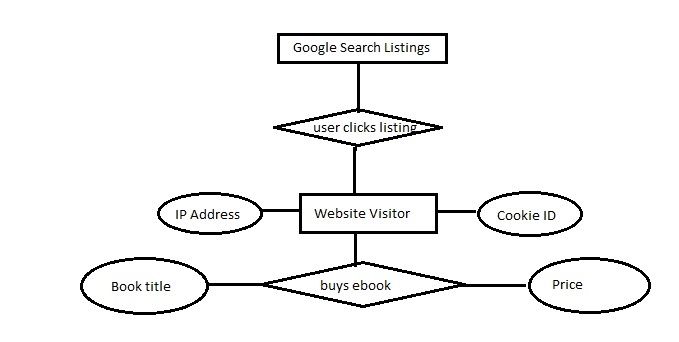
Site visitor has the attributes IP address and cookie id. Site Visitor buys ebook. The ebook has attributes title and price.
Ontology Applied To AI
An ontology applied to AI has significance in the sub-field of Natural Language Processing (NLP), specifically in knowledge representation.

Ontologies are relatively independent of specific systems in that they are made up of generic knowledge and can be applied/reused for different tasks. Data models are rigid and are comprised of ER diagrams that form the database, very specific to that system.
Google’s Knowledge Graph Introduces Semantic Search
The voluminous data sets that Google has built as knowledge bases over the years, is what is commonly known as Knowledge Graph, a network of people, place, events and their relationships.
Google announced that its search engine will search for things, not strings (of text) when they introduced Knowledge Graph in 2012.
A search for Marilyn Monroe yields a variety of rich information (things) and not just text links (strings).
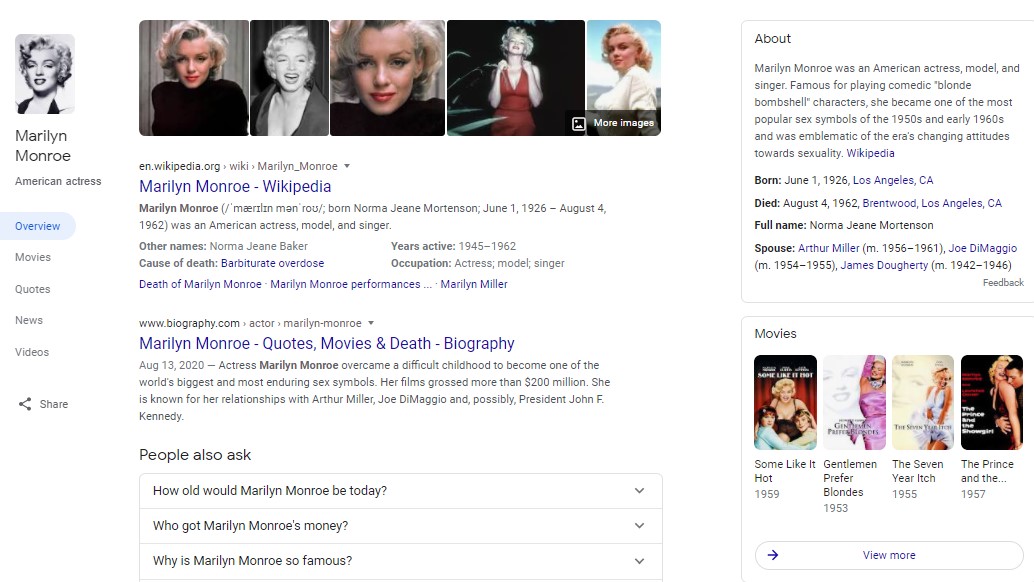
The screenshot is called the Knowledge Graph Card or Panel. It contains all kinds of relevant information about Marilyn Monroe in the form of images, facts and other data.
Information Covered By Google Knowledge Graph
The information covered by Google’s Knowledge Graph grew quickly after launch, tripling its size within seven months (covering 570 million entities and 18 billion facts).
By mid-2016, Google reported that it held 70 billion facts and answered “roughly one-third” of the 100 billion monthly searches they handled. By May 2020, this had grown to 500 billion facts on 5 billion entities.
Source: https://en.wikipedia.org/wiki/Knowledge_Graph
Impact Of Semantic Search On SEO
Hummingbird and RankBrain comprise the bleeding edge of Machine Learning technologies that Google has adopted over time. Users asking questions in the form of voice searches has reached an astounding 50% today, with searches made on mobile devices still numero uno.
You can read more about semantic search and seo in this blog post.
Machine Learning Integrated With Google Search Algorithm
It would be fallacious to think that Hummingbird and RankBrain are distinct algorithms. They are indeed machine learning algorithms integrated with Google’s search algorithm which has been their flagship product since inception.

The fundamentals of the Google search algorithm still matter and it is important to get these vitals right when you create content and to make your site search engine friendly.
1. On Page Optimization
The keywords are the building blocks of any content on the web. This shows the ever increasing demand for good keyword tools and their skyrocketing prices. Long tail keywords account for close to 70% of searches made on Google.
As Google gets more and more conversant with users asking it questions in natural language, the section People Also Ask has become a regular SERP feature. Refer to this blog post about on page optimization It discusses the importance of on page factors like title, meta description, headings and anchor text.
2. Structured Data and Rich Snippets
Google’s Solution To Voice Search
As stated in previous article on RankBrain and its impact on SEO, the voice search queries are exploding and it is Google’s unstated aim to put a Google Assistant in everyone’s pocket. OK Google is going to be their biggest solution to voice search.
The question of pulling out ten high quality most relevant listings here is out of question. Instead, Google has to read out the answer to the user’s voice search question. To do this, it should be able to rapidly find the specific answer from a passage of text and pull out the answer.
Schema Markup To Google’s Rescue
Schema markup involves the annotation of articles or blog posts to expressly announce to Google what the information contained is about. For Google, it is like a shortcut approach to knowing the gist of the page than having to analyze the article in its entirety.
Structured data using schema.org markup are special blocks of code that search spiders pick up very quickly when they crawl and index your site pages. This gives them a really good idea of what the content on the page is really about. You can read more about Google’s structured data markup tools at https://trafficalignment.com/on-page-optimization/
Advantages And Disadvantages of Schema Markup
The biggest advantage is that Google understands what your content on a page is about through the data markup and it is reflected in your site’s listing on the Google SERPs, enhanced by reviews/ratings and an apt description to give the searcher what she or he is looking for.
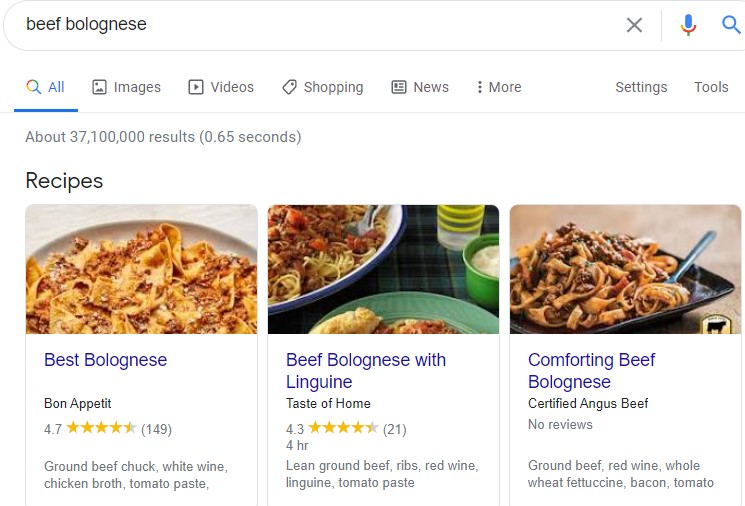
The biggest disadvantage is that it prevents users from visiting your website. Assume your site is a recipe website. If you have a great article for beef bolognese, Google takes the ingredients out of the page and displays it for your listing on the SERPs as an attractive rich snippet showing enough information. The user does not have to click through to your site.
This has also ruffled the feathers of many content creators, including business owners and marketers who are peeved by the fact that Google is appropriating intellectual property of others without giving credit and also leading to loss of remuneration.
You are dealing with a double edged sword in this case, one where your listing is made to look attractive and inviting the user click. On the other hand, the user can just get the required information at a glance and move on to the next search.
Passage Indexing Latest ML Update To Understand A Semantic Web
As of October 2020, Google announced the Passage indexing update for English languages which is a ranking update and affects 7% of search queries.
“Very specific searches can be the hardest to get right,” said Google, “since sometimes the single sentence that answers your question might be buried deep in a web page. We’ve recently made a breakthrough in ranking and are now able to not just index web pages, but individual passages from the pages. By better understanding the relevancy of specific passages, not just the overall page, we can find that needle-in-a-haystack information you’re looking for.”
Source: https://searchengineland.com/how-google-indexes-passages-of-a-page-and-what-it-means-for-seos-342215
3. Backlinks
It is important to remember that PageRank is still a big part of Google’s search algorithm. The popularity of your site’s content is largely determined by the number of votes or links coming in to your content page from other sites on the web. Internal linking also plays an important part in boosting the power of a specific content page. You can read about it at
https://trafficalignment.com/website-structure-important-for-seo-success/
4. Page Load Speed
This is a very critical factor in the ranking algorithm.

Google is indexing pages from the mobile version of your website. It is vital that your site is responsive in that it can display well on both desktop and mobile devices.
5. RankBrain Monitoring Reinforces User Experience
Today, when a user clicks on a Google search listing and ends up on your site in response to her search query, you have to make both your page and overall site user friendly and easy to navigate.

It is critical that you hold the user’s attention with relevant content on the page that closely aligns with with the intent of the user’s search query. There is a concept called dwell time.
Site owners are increasingly resorting to embedded videos even before the content starts to hold the user’s attention and increase the dwell time. RankBrain is monitoring the user’s behavior from the moment the user lands on your site.
If the user hits the Back button in a very short time and returns to the Google SERPs and clicks another listing, RankBrain is learning that your site may not be the most relevant site to list at the top if a number of users exhibit the same behavior.
What Is Aim Of Google’s Semantic Search Engine?
Google’s core business is search although it has delved into other technologies. Google’s aim is to become a smart semantic search engine that is increasingly natural language friendly and more human.
In 2021 and beyond, voice searches are going to take over. Digital marketers and SEO specialists have to keep these developments in mind as they build websites. Just optimizing content for keywords strewn all over a page, like in the past, is not going to make the cut.
You are now dealing with an AI agent who is beginning to attain human thinking like capabilities. Given this situation, let us consider the areas to focus on, listed below.
Latent Semantic Indexing (LSI)
Latent Semantic Indexing is a natural language processing (NLP) technique, a subset of semantics, that scans unstructured data and studies the relationships between the words and the documents in which it appears. It produces a set of concepts linking the terms and documents.

It takes the form of a matrix, with unique words or terms forming the rows and the columns the documents in which they appear.
Math Behind LSI
A mathematical technique called Singular Value Distribution (SVD) reduces the number of rows in the matrix while maintaining the unique documents in the columns.
Each column is a vector and the vector dot product between any two columns is calculated. If the value is close to 1, they are similar documents. A value closer to 0 indicates dissimilar documents.
This technique was developed by Susan Dumais and patented in 1988. This was long before search engines even existed. By technological standards, the rate at which the web technologies have evolved would make LSI a dinosaur.
The jury is undecided on whether LSI still plays a role in search engine algorithms today. There are protagonists and antagonists of LSI. This said, let us get into the specifics of Latent Semantic Indexing.
An article by Bill Slawski that LSI is outdated and is not part of Google’s search algorithm is an interesting read.
LSI In Action
The general misconception is that LSI words are synonyms of the focus keyword of a piece of content that you create. If two words are semantically related, in other words, if they share the same context, then LSI is at play.
Example of LSI
Let us consider the President of the United States (POTUS). An article about the POTUS would be semantically incomplete if a reference to the White House (where he or she lives) or Washington DC (where the White House is located) is missing in that article. This is a classic case of knowledge graph discussed earlier in this article using Ontology.
In short, the President of the US, the White House and Washington DC all share a common context and make complete sense when they appear together. These are often referred to as co-occurrences in linguistics.
Co-Occurrence In Linguistics
Co-occurrence refers to appearance of two terms that are semantically related anywhere in a document. They don’t have to be necessarily adjacent to each other. If a document is on home-brewn beer, then somewhere in that document, you should expect to see its co-occurrences, namely malt, hops and yeast.
Collocation In Linguistics
Collocation is normally two words that generally appear together, often adjacent to each other. For example, the word accomplice has only a negative connotation. It is always going to be accomplice in crime. It will be almost impossible to see usage of accomplice in charity.
Benefit of LSI
When Google started off as a lexical search engine, the emphasis was on keywords. This led to keywords used repeatedly on a web page to make it clear to Google what the page is about. Keyword density ruled the web during this phase.
Black hat SEO gained precedence with doorway pages stuffed with keywords shown only to search engine bots and not to humans. The top results on Google SERPs were low quality content pages packed with keywords, leading to poor quality search experience. LSI helps Google weed out such poor quality keyword stuffed sites.
LSI Helps Prove To Google – Are You An Expert?
LSI emphasizes on the use of semantically related words/phrases that is contextually connected with the focus keyword of a piece of content.
When you are considered an “authority” in your subject domain, the knowledge you have gained through experience (aka wisdom) is reflected clearly in your writing. Your writing will be natural and contain contextually relevant phrases/words. Keywords will not appear to be inserted on purpose.
This natural flow would be hard to mimic by someone who is not experienced in your domain of expertise. This is how Google can analyze the content on a topic and confirm if the broader related words that are topically relevant is present in the piece of content.
Google Shows Related Searches
If a user searches for the phrase – decision tree, the knowledge graph panel is displayed with result displayed from the most relevant site.
At the bottom of page 1 of the Google SERPs, Google gives an idea of terms that are closely related to the search phrase decision tree.
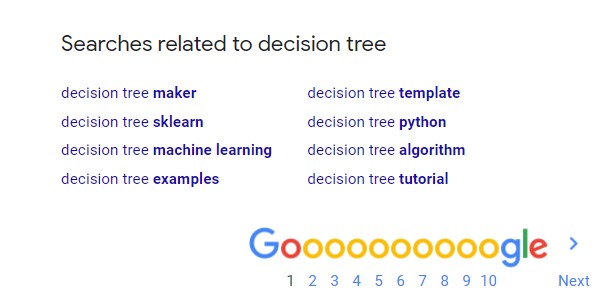
Google Search Results Bear Testimony To LSI
A search for the phrase weight loss pills shows ten natural search listings on Page 1 of Google SERPs. Only 3 listings have the same phrase as the search term. ie. weight loss pills. Only one listing has the search term in its meta description.
In most cases, the words supplements, diet and medication have replaced either weight loss or pills. Again, these replacements are not exactly synonyms. They are more semantic variations of the original search term.
NOTE: It is to be emphasized here that LSI is an antiquated mathematical algorithm that was created more than 30 years ago. We have seen the impact of AI and specifically Machine Learning that have produced Hummingbird, RankBrain and Knowledge Graph.
With such sophisticated technologies available, I agree that LSI may have played a role in the evolution of search engines from lexical to semantic but there is no guarantee that it is being actively used to this day. There are other advanced algorithms that are increasingly impacting search engine optimization.
Semantic Search Is Here To Stay
Give up on the old habit of optimizing for keywords. Focus on the semantic search engines that are driven by Machine Learning. Write content naturally with words that are semantically related to the main keyword phrase. Bring structured data and LSI into play.
At Traffic Alignment, we provide search engine optimization services for small businesses to help them gain a strong foothold in the Google search engine landscape. A modest investment of paid social advertising is involved. Contact us today for your seo marketing needs.
Related Posts
















Leave a Reply