
How To Future Proof Your Website In 2021
With Google becoming an AI first company, and search its flagship product, all its algorithms have Machine Learning (ML) at their core.
For natural search, it is Rankbrain that updates rankings in real time based on user behavior on the Google SERPs.
ML driven paid search algorithms have smart bidding at the core of Google Ads, allowing advertisers to use Target CPA (Cost Per Account) Bidding bid strategy. Now, import the Smart Goals into Google Ads. Let it run for a few weeks to gather data.
To calculate the CPA, divide the total amount spent by the goals achieved in that time period. You can set this as the target CPA. Both natural search and paid search are driven by such sophisticated algorithms today.
Let’s now look at the 6 ways to future proof your website in 2021.
1. Responsive Design
Let’s admit that the mobile phone has singularly transformed the 21st century bringing on-the-go web technologies to majority of the world’s population.

The plot thickens when mobile technology is growing explosively that the site has to render on folding phones. It’s only a matter of time before everyone has a folding phone in their hands.
The challenge is not about rendering a website but changing dimensions in real time to accommodate new versions of mobile phones. It’s not enough that your site’s theme is mobile responsive to suit just desktop and the mobile phones in vogue today.
To boot, Google has been crawling and indexing the web using a smartphone Googlebot since March 2020. The indexing of all websites started in Sep 2020 and has continued ever since.
Source: https://developers.google.com/search/blog/2020/03/announcing-mobile-first-indexing-for
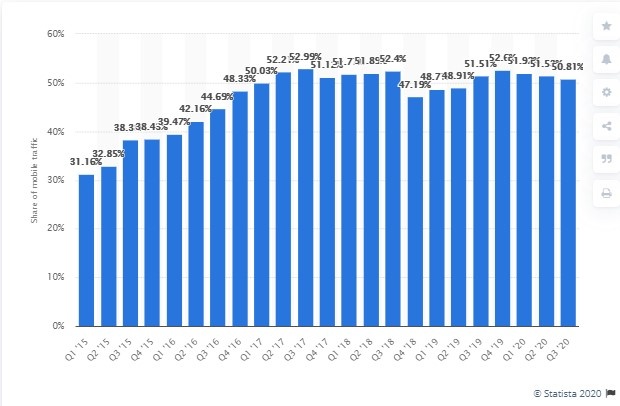
Below is a screenshot showing the mobile device website traffic from Q1 2015 to Q3 2020. This shows the importance of responsive web design where a website has to render properly on mobile phones and tablets.
Source: Statista.com
2. Page Load Speed Is Critical
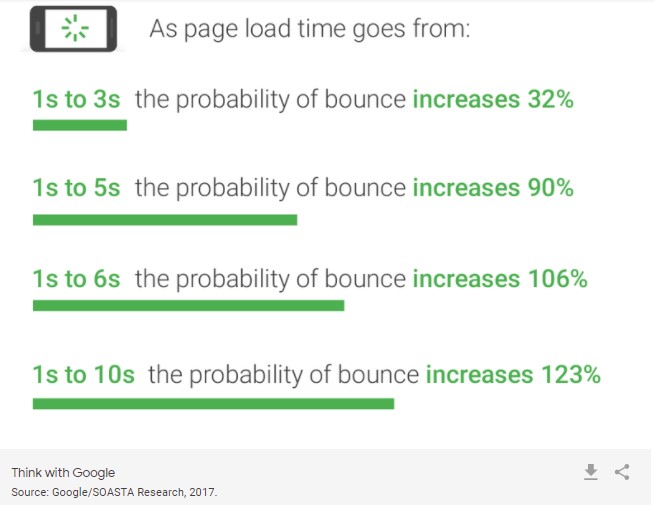
Recent research by Google on page load times reveals some startling facts. As the page load time increases, the bounce rates go higher and higher. In effect, speed equals revenue.
If you are using WordPress, my favorite picks are WP Rocket and Autoptimize. WP Rocket is a very powerful caching tool and enables websites to load at really fast speeds. Autoptimize does a wonderful job in reducing the page size and making it lightweight.
Source: ThinkWithGoogle.com
3. Content Management System (CMS)
WordPress came into existence in May 2003 and has not looked back. It is so easy to install and use as it adapts so well to the ever evolving web technology field.
The main reason for its popularity is the amazing new functionality added to a WordPress site by a piece of code called plugin. It can solve any problem you may encounter while serving the online needs of your visitors.
A huge global community has been building plugins to add functionalities and solutions to problems faced by WordPress site owners. It is guaranteed to exist for quite a while from now.
4. Create Evergreen Content
Let’s be practical when we talk about evergreen content. This does not apply to all niches/industries. It relates to the topics of interest, one that affects the lives of people at large.
Losing weight, creating the best homemade pecan pie, these are classic examples of evergreen content. The basic principles are the same. One can get creative by changing the ingredients or developing a new type of plant diet, for example. These are sought after tips by majority of the populace.
If it is a specific niche like an industrial process or a product like selfie stick, well, they have their limitations and there is not going to be an incredible change in how they are manufactured. There is not much stellar content to write about and/or creating new content.
5. Media Rich Design For The Future
One of the major points listed above related to page load speeds. This section is something you can revisit in future, if you are a website owner or web designer.

With the advent of 5G technology, loading times will not pose major problems. A video playing on page load will not drag or have adverse impact on page load speeds.
Even if you stick to good design principles, your competition can go to town with animations or high def images all over the page. This might force you into the act and perhaps that is going to be the state of the web in future.
Get prepared for this mentally today and envision a futuristic web where page load speed will not play spoilsport.
6. Smart Image Search
As of date, all images uploaded to the web have an alt and/or title tag describing what the image is about. This serves a twin-fold purpose in that the search bots are still at a stage where they cannot understand the meaning of an image. This also helps visually impaired people who depend on the alt tag to understand what the image on a web page is about.

Source: Google Blog
With rapid advances made in computer vision and visual computing, machine learning uses these applications in many real world areas like autonomous driving and robotics.
A product like Google Lens is an image recognition technology that throws up information relevant to the objects it is pointed at through a phone camera.
Google Lens is an image recognition technology developed by Google, designed to bring up relevant information related to objects it identifies using visual analysis based on a neural network.[2] First announced during Google I/O 2017,[3] it was first provided as a standalone app, later being integrated into Android’s standard camera app.
Source: Wikipedia
It is therefore only a matter of time before Google can look at the content of images and interpret their meaning correctly. This will contribute an even more powerful form of image search in future, relative to its current state.
At Traffic Alignment, we follow best practices in search engine optimization of small business websites to lay a solid foundation for them to rank well in the search engines. Give us a call today to find more about what we can do for small businesses.
Related Posts














Leave a Reply